Why the Same Three HVAC Companies Get Named in Every Neighborhood Thread
Read a year of neighborhood recommendation threads in any town and the same two or three HVAC companies keep appearing. It isn't because their work is two or three times better — it's because the surface itself compounds in their favor.
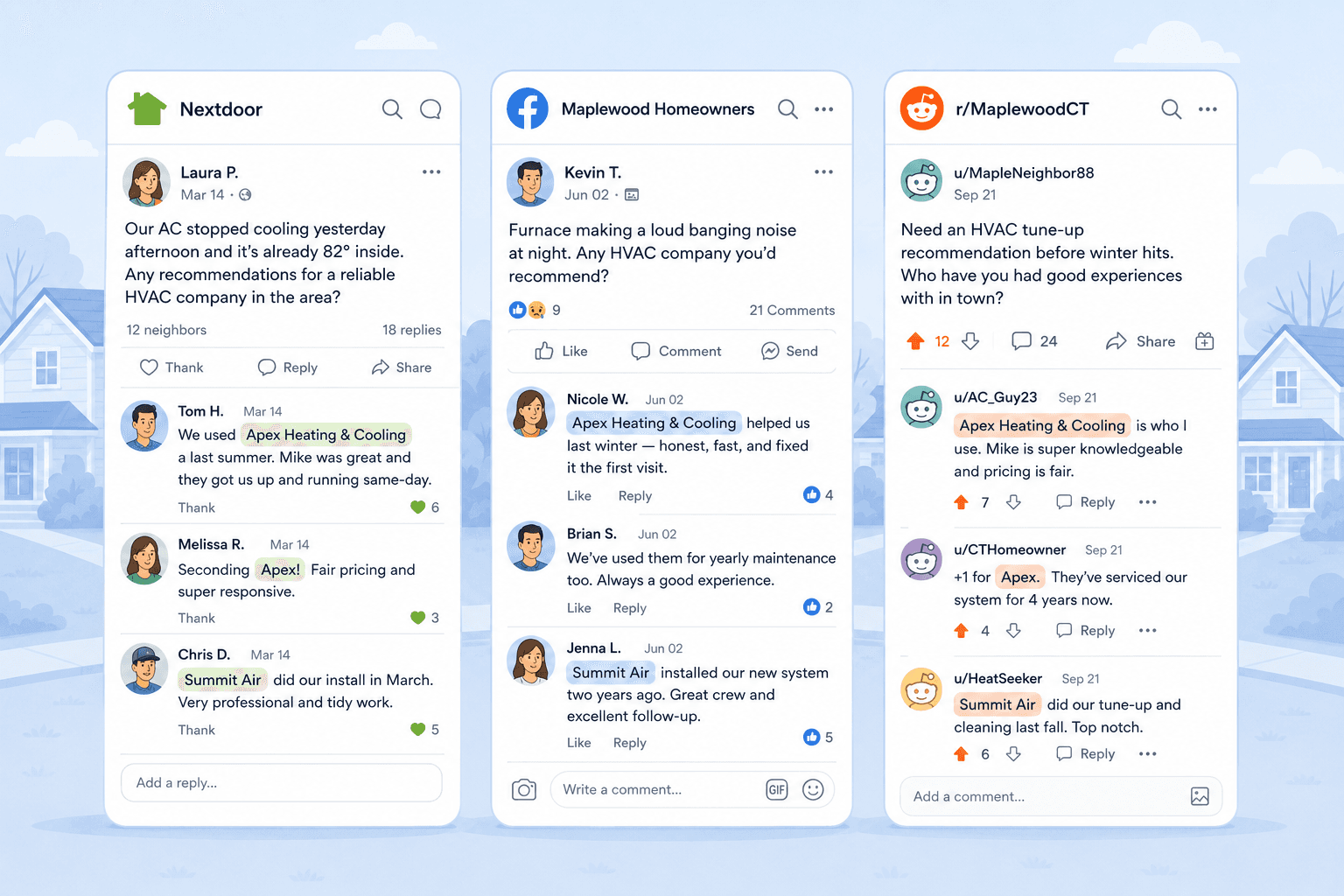
Read a year of HVAC-recommendation threads in a single neighborhood — across Nextdoor, the local Facebook group, the town subreddit — and a pattern jumps out fast. The same two or three HVAC companies keep showing up. Different homeowners, different breakdowns, different streets, same names.
That pattern holds in essentially every market we look at. And it's not because those two or three companies are doing two or three times better work than everyone else. The math doesn't fit. Something about the recommendation surface itself produces the result.
The cross-thread compounding nobody talks about
Most operators understand the within-thread dynamic — that the first sixty minutes of a single recommendation thread lock in who gets the call. What gets less attention is the cross-thread dynamic. The same forces that decide one thread keep deciding the next one, and the gap between the named companies and everyone else widens with every cycle.
Three things compound across threads, not just within one:
The active commenters are the same people. Nextdoor and local Facebook groups are not anonymous, and the small group of neighbors who routinely answer "anyone have an HVAC company?" questions tend to answer the next one too. They remember who they recommended last time. Thread two looks like thread one because the person typing the answer is the same person, recalling the same name, six months later. You're not winning a thread — you're being kept in the active local memory of a handful of neighbors who like to be helpful.
Old threads become search artifacts. When someone posts a new recommendation request, the most engaged neighbors often don't just answer from memory — they scroll the group's history, find last year's thread, and surface the same names again. Every time your business name lands in a thread, you've added a small permanent reference that re-emerges the next time anyone searches the group for "HVAC" or "AC repair."
Each mention raises the bar to displace you. Once two or three names are circulating, introducing a new name reads to neighbors as either contrarianism or self-promotion — both of which carry social cost. Most won't bother. So the incumbent two or three companies don't just stay; they get harder to dislodge the longer they're there. The gap widens.
The binary asymmetry
Combine the three and you get an uncomfortable result. An HVAC company that's named in three threads gets selected for the fourth. A company that has never been named has no on-ramp at all. The difference is not a 30% performance gap — it's structural absence. You're in the conversation or you aren't.
This is why being better on the actual installs and repairs doesn't, by itself, move you into more threads. Quality is the precondition for staying in the conversation once you're in it — the floor, not the ladder. What gets you into the conversation in the first place is being named, by a real past customer, in a real thread — once, and then again, and then again, until the local commenters start typing your name reflexively.

What this means for an established operator
The temptation, when you see this pattern, is to try to be in every thread — to set up alerts and have someone on your team comment whenever a request comes up. That doesn't work, and it doesn't work in two specific ways. First, neighborhood-group moderators flag and remove self-promotional comments from businesses, and your account ends up degraded or banned. Second, a comment from your business account is worth a fraction of what an unprompted mention from an actual neighbor is worth, because everyone reading the thread can see the difference instantly.
The lever isn't volume. It's getting named by past customers without prompting, repeatedly, over enough threads that the local active commenters start including you in their default answer set.
That happens when three operator-side things are in place:
- Your past customers can recall your business name without effort. "The guys who fixed our AC" doesn't end up in a thread. "Apex Heating & Cooling — Mike came out same-day" does.
- The right past customers are active in the right local groups. A happy customer who isn't in your service area's Nextdoor doesn't help you there.
- The mention happens while the thread is still live. Within-thread timing still matters, but the cross-thread effect only kicks in if you're in enough threads in the first place.
These aren't marketing tactics in the conventional sense. They're operator decisions — how you wrap up a job, how you talk about your business with customers, which neighborhoods you've systematically served, what name people actually use when they refer to you.
The threads you're not in
The hardest part of this dynamic for an established HVAC company to see is the threads they aren't in. Every week, somewhere in your service area, neighbors are asking for an HVAC recommendation. Two or three names get mentioned. Yours either is or isn't among them. If it isn't, you have no signal — no notification, no email, no scoreboard. The thread just happens, and you're absent from it.
If you want a baseline picture of how often your business name actually shows up in your local recommendation surfaces, request your free neighborhood report. It's a snapshot of the threads you're not seeing. For the broader argument about why this surface matters at all, the founding post covers the rest.
The same three HVAC companies get named in every thread for a reason. Whether you're one of them isn't decided by the quality of your work. It's decided by whether you've done the specific operator work that makes a past customer reflexively type your name.